

Mental health support for elite athletes requires whole-system approach — IOC
ResearchStellenbosch University October 13, 2026 News desk
Elite athletes must be in tip-top shape, while also dealing with the intense pressures that come with competing at the highest level. This can affect their mental health.
Therefore, mental health support for elite athletes requires a whole-system approach that combines proactive, individualised care with supportive training environments, strong safeguarding and leadership, routine screening and well-prepared organisational systems. Such support should also take local contexts and conditions into account.
This is one of the key messages of a new consensus statement on mental health in elite athletes released recently by the International Olympic Committee (IOC). This statement, which is an updated version of a 2019 statement on the same topic, was published in the British Journal of Sport Medicine.
Led by Dr Claudia Reardon of the University of Wisconsin School of Medicine and Public Health, the 2026 statement was compiled by an IOC Consensus Group that included individuals with lived, clinical and/or scientific expertise in the mental health of elite athletes, an athlete representative, as well as two International Sports Federation representatives.
“This consensus statement represents the work of a six-continent workgroup tasked with reviewing the world’s research on mental health in elite athletes. From there, we published our findings, which include what we know about the epidemiology (how and why groups of people get injured and sick, and how to prevent it), prevention, and management of mental health in elite athletes. Importantly, in this statement, we really wanted to convey that the environment that surrounds athletes is highly impactful when it comes to their mental health,” says Reardon.
“Mental health is not simply a product of the individual athlete. It is also a product of the relationships that exist in sport, of the culture of sport, of media and social media portrayals, and of many more aspects of the environment.
“It is also abundantly clear to us that mental health is not the same everywhere in the world. Stressors, environments, contexts, and even symptoms are different. That is why it was so critically important to have experts from low- and middle-income countries in our consensus-writing workgroup,” adds Reardon.
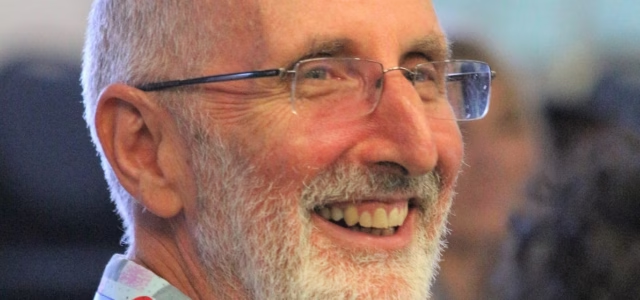
Echoing Reardon’s sentiments, one of the co-authors, Prof Leslie Swartz of the Department of Psychology at Stellenbosch University, says, “Mental health is a key component of the health and overall well-being of elite athletes. The responsibility for prevention, recognition and management of mental health symptoms and disorders and for promoting well-being extends across the entire elite sport ecosystem.”
According to Swartz, the potential benefits of this consensus statement include increased awareness of the importance of mental health in elite sport, improved quality of health care afforded to elite athletes and up-to-date information which can be adapted to different contexts by those working with elite athletes.
“It will also ensure that clinicians, coaches and sport organisations are prepared to recognise, respond to and proactively support that mental health is essential to safe, ethical and sustainable elite sport participation.”
Highlighting the need for a new consensus statement, the authors point out that elite athletes experience mental health symptoms and disorders at rates similar to, or higher than, the general population, but their symptoms and support needs may differ from those of non-athletes.
They note that, in addition to a whole-system approach, the statement calls on clinicians and sport organisations to proactively address stigma, confidentiality concerns, fear of deselection and low mental health literacy as part of routine elite athlete care. Sport organisations should also implement routine screening and surveillance of elite athlete mental health at predefined times and following significant events.
“Elite athletes should receive targeted mental health screening and support before, during and after major transitions in sport. These athletes’ psychological responses to injury should be routinely assessed, and return-to-sport for those with mental health symptoms and disorders should incorporate athlete safety, stability and function as guiding principles.
“Mental health screening and support for elite adolescent athletes should reflect developmental stage, educational demands, family dynamics and the early onset of many common mental health disorders.
“Mental health assessment and care for elite Para athletes must account for disability-specific stressors, accessibility barriers, classification systems and heightened transition risks.”
According to Swartz, there has been increasing concern about the mental health and wellbeing of elite athletes. As a result, consensus statements have been written on this topic to consolidate what is known about mental health of elite athletes and to make recommendations for athlete care but also further research. He says the IOC convenes expert groups on several topics, and there have been statements on, for example, violence in sport and injury and illness epidemiology.
Since the growing interest in mental health in the elite sport may be fuelling research collaborations and athlete advocacy about the importance of this issue, the IOC Consensus Group have also released an agenda for research that is relevant to mental health within the elite athlete ecosystem. This research agenda, which is informed by elite athletes and global leaders in mental health research and clinical practice, can help ensure that high-priority areas are addressed.
To highlight the IOC’s commitment to culturally and resource-appropriate mental health prevention, promotion and care, an editorial on mental health in elite athletes from low- and middle-income countries has also been published.

News desk
News desk writes, collates and publishes relevant news for Yiba.


