
Universities challenged to rethink teaching, learning in the age of AI
University of KwaZulu-Natal October 12, 2026 News desk
The future of higher education may depend on universities asking harder questions about how students learn, whose knowledge is valued and what should remain uniquely human in the age of artificial intelligence (AI).
From the risks of AI adoption to the need to decolonise knowledge, leading academics are challenging universities to rethink the foundations of teaching and learning.
This was at the centre of the fourth Innovations in the Science of Teaching and Learning Conference hosted by the University of KwaZulu-Natal (UKZN), where more than 300 academics and students from diverse disciplines explored how universities should respond to a rapidly changing world. The conference was held recently at the Elangeni Hotel in Durban.
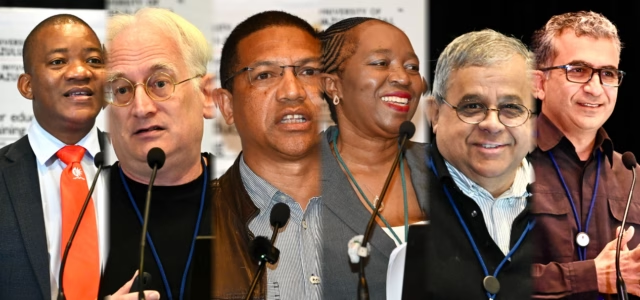
Conference host and UKZN Deputy Vice-Chancellor: Teaching and Learning, Professor Thabo Msibi addressed delegates, saying that universities are operating at a particularly consequential moment, as global uncertainty, contested ideas about truth, knowledge and identity, and rapid technological change increasingly enter the classroom.
“When the world changes, teaching and learning cannot remain unchanged,” said Msibi.
He urged delegates to recognise that this change requires a more interdisciplinary and human-centred approach.
The keynote speakers brought this argument into focus, examining the changing nature of knowledge and learning from different perspectives.
Transformation in higher education was most sharply illustrated in a presentation on AI, with University College London academic Professor Wayne Holmes questioning the speed at which universities are incorporating AI into education without sufficient evidence of its effectiveness, safety and impact on students.
Holmes, who teaches Critical Studies of Artificial Intelligence and Education, argued that AI can enhance teachers’ work but cannot replace them. He warned that universities risk embracing technology before fully understanding its consequences.
“On the surface of it, AI is amazing but the reality is far different,” he said, calling for greater regulation and cautioning that AI could offer “short-term gain” while creating “long-term pain”.
For Professor Oscar Koopman, the AI debate goes beyond questions of regulation. It reaches into the very process through which students develop knowledge and understanding.
While the internet expanded access to knowledge, Koopman who is the Acting Dean of the faculty of Education at Stellenbosch University, argued that AI is different because it increasingly enters the process of reading, interpreting, comparing, writing and thinking.
He urged universities to protect what he described as the “soul” of education – the uncertainty and reflection through which students develop their own understanding.
His argument raised a fundamental challenge for educators: if AI can provide an answer before students have wrestled with the question, are universities at risk of removing the very struggle through which meaningful learning takes place?
The question of meaningful learning must also take into account what students bring with them into the classroom.
Professor Sinegugu Duma, a UKZN academic and an internationally recognised scholar in gender-based violence, forensic nursing and Higher Education transformation, called for trauma-informed pedagogy to become “embedded in the DNA of universities”.
“Students may arrive in the classroom carrying the effects of Gender Based Violence, protests, food insecurity, cyberbullying, and broader social and historical inequalities.”
For Duma, this means educators must consider not only what they teach, but how they teach and whether students experience physical and virtual learning spaces as “psychologically safe.”
The question of student experience intersects with an equally fundamental question: whose knowledge is being taught in the first place?
Professor Sandew Hira, an independent scholar and decolonial thinker from The Hague in the Netherlands, challenged universities to confront the dominance of Eurocentric knowledge systems, arguing that much of the academic material used in universities continues to originate in the Global North.
He called on institutions in the Global South, particularly those in Africa, to become producers rather than primarily consumers of knowledge by developing textbooks and curricula that reflect African and other Global South perspectives.
Decolonising disciplines, Hira argued, involves more than adding alternative voices to existing curricula. It requires the reconstruction of disciplines and the creation of new knowledge systems.
Professor Siddique Motala, a Professor of Civil Engineering at the University of Cape Town, demonstrated what this could look like in practice through his work on “counter-surveying”.
In his address, ‘Cartography, Heritage and Hauntings’, Motala showed how mapping, technology and community memories can be used to recover histories that have been marginalised, including the experiences of communities affected by forced removals during apartheid.
His approach challenged educators to consider engineering and technology not simply as technical tools but as ways of recovering and preserving heritage.
“As educators, are we exploring other ways of knowing and being?” Motala asked, urging academics to retell histories without “primitivising” communities and to create space for ancestral voices to be heard on their own terms.
The speakers demonstrated how major challenges confronting society intersect in the classroom: where technology is changing how students think, trauma shapes how they learn, histories influence what they know, and questions of power determine whose knowledge is recognised.
Across disciplines, delegates explored how AI, trauma, inequality, identity, history and competing knowledge systems are reshaping the student experience, echoing Msibi’s call for a more interdisciplinary and human-centred approach to Higher Education.

News desk
News desk writes, collates and publishes relevant news for Yiba.


