
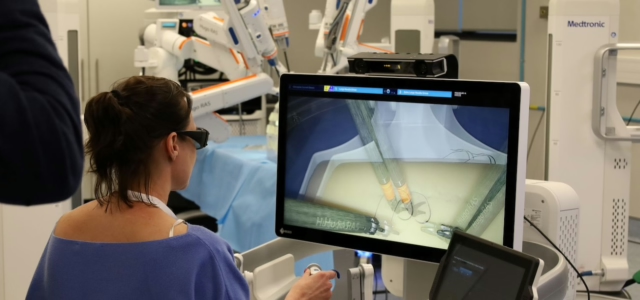

Decade of surgical training excellence for university, expands into robotic-assisted surgery
Stellenbosch University August 21, 2026 News desk
The Sunskill Surgical Skills Training Centre at Stellenbosch University (SU) recently celebrated 10 years of excellence in surgical education while marking a significant new chapter in its development with the launch of robotic-assisted surgery training.
Established through a long-standing partnership between SU and global healthcare technology leader Medtronic, the Centre has become a leading platform for surgical education, skills development and healthcare innovation in Africa. Its expansion into robotic-assisted surgical training further strengthens its role in advancing cutting-edge surgical practice, technology adoption and patient care across South Africa and the continent.
“We are pleased to celebrate this significant milestone with the Sunskill team. For more than a decade, the Centre has provided world-class hands-on education for surgeons and other healthcare professionals, supporting clinical excellence, technology adoption and improved patient care across Africa,” said Prof Karin Baatjes, Vice Dean: Learning and Teaching in SU’s Faculty of Medicine and Health Sciences (FMHS). “Over the years, Sunskill has developed into a centre of excellence that attracts healthcare professionals from across the continent and beyond. We are equally excited about its next chapter as it expands into the rapidly evolving field of robotic-assisted surgery training.”
Located within SU’s Biomedical Research Institute (BMRI) in Cape Town, Sunskill is one of Africa’s leading surgical training and education facilities. Since opening its doors in 2016, the Centre has supported the professional development of more than 10 000 healthcare professionals through over 800 educational and hands-on training events, providing access to advanced medical education, innovative technologies and expert-led clinical skills development.
Over the past decade, Sunskill has welcomed surgeons, nurses, clinical engineers and multidisciplinary healthcare teams from South Africa, elsewhere on the continent and internationally. Through hands-on experiential learning, the Centre has helped healthcare professionals develop practical skills that contribute to improved patient outcomes and strengthen healthcare systems across the region.
“The expansion into robotic-assisted surgical training marks another important milestone in Sunskill’s evolution,” said Prof Ian Vlok, Director of Sunskill and Head of SU’s Division of Neurosurgery. “This new offering opens opportunities for surgeons from South Africa and across Africa to gain exposure to one of the most significant technological developments in modern surgery. By providing access to advanced robotic-assisted surgical training, Sunskill continues to equip healthcare professionals with the skills and confidence needed to deliver the highest standards of patient care.”
The Centre will now offer training opportunities on Medtronic’s Hugo Robotic-Assisted Surgery (RAS) system. Designed for use in general, urological and gynaecological surgery, the Hugo RAS platform combines articulated robotic arms, high-definition three-dimensional visualisation and an open-console design that enables greater collaboration among members of the surgical team in the operating theatre.
Its modular architecture and ergonomic design provide flexibility across a range of procedures and surgical disciplines, while enabling surgeons to perform complex interventions with enhanced precision, control and visualisation.
Background
In July 2016, SU, in partnership with Medtronic, officially opened the purpose-built Sunskill Surgical Skills Training Centre within the FMHS. The facility was established as a state-of-the-art, integrated clinical training environment aimed at transforming access to world-class healthcare education and skills development across South Africa and the broader sub-Saharan African region.
From the outset, Sunskill’s mission was to provide healthcare professionals with a safe, highly realistic environment in which to learn new techniques, refine existing skills and build confidence before treating patients.
The Centre offers training across a wide range of surgical disciplines and healthcare professions. These include simulated operating theatre sessions for specialist surgical training, minimally invasive and keyhole surgical techniques, neurosurgery, micro- and endoscopic surgery, as well as training for general surgeons, plastic surgeons, urologists, ENT surgeons, orthopaedic surgeons and critical care physicians.
Its dual wet and dry laboratories also support primary healthcare practitioners, nurses and other healthcare professionals in developing specialised skills such as central venous line placement, emergency airway management and intensive care unit procedures.
In addition, Sunskill has established itself as a platform for post-specialist training on new technologies and methodologies, enabling healthcare professionals to continually update and expand their expertise as medical science and technology evolve.
“As a transplant surgeon, I have a deep appreciation for the value that surgical expertise brings to patients’ lives. Surgery saves lives, improves outcomes, shortens hospital stays and can reduce healthcare costs,” said Prof Elmi Muller, FMHS Dean. “However, surgery requires far more than knowledge alone. It is a highly sophisticated technical skill that demands continuous practice, refinement and dedication. I am particularly proud of the contribution that SU and the Sunskill Surgical Skills Training Centre have made to advancing surgical education and excellence on the African continent over the past decade.
“The Centre’s impact is reflected in the thousands of healthcare professionals it has trained and the many patients who have ultimately benefited from improved clinical care. As Sunskill enters its second decade, we are excited about the opportunities presented by robotic-assisted surgery training and the role the Centre will continue to play in shaping the future of healthcare in Africa.”

News desk
News desk writes, collates and publishes relevant news for Yiba.


