


Dr Tebogo Mashifana- a role model for young women
AchieversGautengLatest newsUniversity of Johannesburg August 12, 2020 News desk
According to an online article published on Lead5050.com, ambitious women need female role models who have been successful in order for young girls to be motivated to reach success in life. The author said: “Female role models are important for ambitious women. If we can’t look up and see women who have been successful, we are less likely to be successful ourselves. The presence of women in leadership positions and the opportunity to network with them is vital to helping motivate women to advance in their careers.”
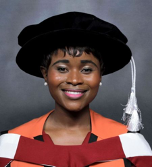
One such successful woman is 34-year-old Dr Tebogo Mashifana from Sehlakwane village in the Limpopo Province. She is a Senior Lecturer in the Department of Chemical Engineering Technology at the University of Johannesburg (UJ).
Like many children who grow up in rural areas, Dr Mashifana had no idea what a PhD was for most of her childhood. To this day, many kids in the rural areas do not have access to smart phones and computers or well-equipped community libraries with internet access. This was the same for her. “Growing up, I did not have access to information or career guidance, I did not even know what a PhD was. However, I at some stage in my teenage years, I remember telling my parents that I will study until I become a doctor. Most probably the doctor I was referring to was a medical doctor.
“The desire to study and attain a PhD developed when I enrolled for my Master’s degree. The passion I had for research and investigating solutions to some of the challenges related to environmental pollution is what made me to continue studying to a doctoral degree level,” says Dr Mashifana.
One of the ambitious objectives of the National Development Plan of South Africa is to produce 100 doctoral graduates per million people by the year 2030. This, according to Dr Mashifana, is more than just a numbers programme but more of an intervention to have enough solution bearers. “As a country we are experiencing numerous challenges in every sector and most of these challenges require dedicated individuals to conduct research, investigate and apply knowledge-based solutions to address some of the problems. There is no doubt that education is a spine of every country and attaining a PhD enhances one’s ability to conduct valuable research and solve problems. Ultimately, it is about creating a knowledge-based society and economy, for the development of our country,” she explains.
Having a doctoral degree provides brings about a variety of opportunities and benefits. These includes post-doctoral studies, where one continues to do doing research and adding value to society and the county as a whole. Most importantly, I believe that in the process of attaining a PhD degree, one is exposed to other opportunities through the research conducted. My own personal experience, post PhD, has been that I was able to continue investigating solutions related to environmental pollution. However, the critical aspect of my research post PhD, is that I am developing solutions for real time problems and also establishing relationships in the industry. Therefore, it is not entirely about the opportunities that will be presented to you when you have a doctoral degree, but about what you are doing with the knowledge and the skills you have acquired throughout your PhD journey. The truth is the world is waiting for solution bearers and solution providers,” says Dr Mashifana.
She adds that attaining a doctoral degree is neither difficult nor easy. Rather, it is a journey that requires 100% dedication and commitment, sacrificing time for social activities and with family, and enduring more sleepless nights and spending hours in the laboratory doing research. “If you have a clear vision of what you want to do and where you are going, you will also understand, whilst in the journey that at the end, all your sacrifices are seeds that will yield fruits,” she says.
She encourages students who are passionate about research and providing solutions to the many problems experienced in South Africa, the African continent and the rest of the world, to pursue doctoral studies. “There are people who are passionate about research and are already in the Research space with Masters degrees, would it not be even more valuable to continue doing what you love doing, but doing it under the umbrella of a PhD, that at the end, you do not only solve problems or provide solutions but you also attain a doctoral degree? Often many people see a PhD as something that is complicated, too far-fetched and a degree that is designed for a selected few and that is the perception we need to change,” Dr Mashifana asks, emphasising why people need to pursue studies to the highest level.
In her engineering field and as a lecturer, Dr Mashifana says it is extremely important to have a PhD. “It is basically one of the minimum requirements for one to be a Senior Lecturer. As a Chemical Engineer and a Researcher, a PhD is important for so many reasons; such as collaboration, reputation, etc. We live in a world where knowledge is considered as the ‘new fuel’ and highly educated people with professional and technical skills are key for the creation of knowledge-based economies,” she says.
The right time to study towards a doctoral degree, she says, is whenever one starts thinking of pursuing a PhD – either during their Master’s studies or after attaining it. “My personal advice to students would be to never stop studying until PhD level. When the thought of a PhD crosses your mind, do not ignore it. I am a firm believer that whatever our minds can conceive, we have the ability to accomplish,” she says.
Dr Mashifana’s sentiments and message to encourage other women in celebration of Women’s Month: “The brave women that came before us have fought and won some of the battles for themselves and us – we are enjoying the fruits of their sacrifices today. We continue to be confronted by many difficult challenges of patriarchy, gender-based violence, gender pay parity, and making our voices heard, but if there is anything no one can take away from you is your knowledge and the skills you have acquired. As difficult as the PhD journey may look, more especially for women who have so many other responsibilities, I would like to say to them it is possible. Let us make education fashionable while we add value to our country.”
Source: UJ

News desk
News desk writes, collates and publishes relevant news for Yiba.


