
Activating change through self-discovery
ArchivesLatest news October 5, 2017 News desk
What happens when you take eight strangers, add 12 values and activate their inner wisdom? That’s what UCT alumnus Mustapha Hendricks and co-producer Lutz Manzelmann wanted to find out when they were filming The Activation Camp.
The feature documentary follows on from The Activation Game, a multimedia, interactive, self-development book written by Hendricks and Manzelmann.
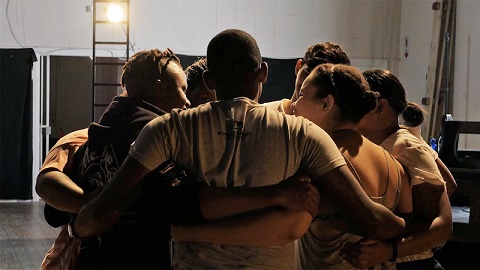
Among the audience at the film’s premiere on 18 September at the Labia Theatre in Cape Town were the eight participants on the inaugural The Activation Camp who began the journey as strangers but ended as friends. Their nine-week activation journey included weekly sessions at various venues across Cape Town, from a church in District Six to a theatre in Observatory.
The basic premise is that each individual carries the tools within them to live a fulfilled and meaningful life. What is required is the awakening of their inner wisdom and The Activation Game endeavours to do just that. Each week centres around a core value – trust, honesty, integrity, to name just three.
An essential element of successful personal relationships, trust, is dealt with in one of the initial sessions. Lutz as the facilitator has to establish the group’s trust. For the group, this establishment of trust was an essential part of their feeling comfortable with the process and proved to be a pivotal point for many of them.
The Activation Camp documentary follows their journey of self-discovery under the guidance of Lutz as Hendricks documents their experiences. The participants – Hiroshi Tahir Adaniya, Odwa Getyes, Nicole Jones, Landile Mchunu, Lubalo Ndabula, Katlego Sejanamane, Caefus Tladi and Lucy Wills – include seven UCT students.
There are many tears, much laughter and moments of intense honesty as each member of the group undergoes different levels of personal catharsis. They all come from different backgrounds and arrived at the camp at a different stage in their personal growth.
Personal realisations
 For Katlego Sejanamane the course offered a sense of personal freedom, something that he had been actively seeking. Growing up, his peer group was older than him and he was constantly told to “man up”, to “start acting like a boy, stop acting like a kid”.
Reflecting on his childhood he explains, “You never gain acceptance for who you are. It almost felt as if I was living inside a prison in my head. I had to live a certain way. I couldn’t be me. I wanted a place where I could feel things.”
For him, the most important thing is caring for the people around him.
“There are not enough people who care in the world,” he says as he expresses concern at the number of students who attempt suicide and the special pressure felt by bursary students who live in constant fear of failure.
 A student in social work who had initially wanted to become a dancer, Caefus Tladi was frustrated at the sense that he has been putting off his life for some time.
“I’m beautiful now, but when I was seven I was luminous,” he recalls.
His first goal was to be able to accept himself, including his background, limitations and sexuality.
Lucy Wills felt that she had lost touch with who she was.
 “I don’t really know myself any more. I let go of the things that I know about myself. I just want to be a better person. If I don’t love myself, there’s no way I will be able to love my children.”
She felt that she had nobody that she could confide in. She suffered from an eating disorder and hated her body and her life.
“I’m tired of pretending all the time,” she says.
Emotionally charged moments
The documentary was created to inspire people, young and old, to try the programme. The film follows the participants’ progress, highlighting the moments of self-revelation and the strength they gather from each other.
The ultimate aim of the programme is for participants to find their inner wisdom and not to rely on external guidance. There are moments when each individual has a personal epiphany and their frank honesty are emotionally charged, but the camera doesn’t focus unnecessarily on their most vulnerable confessions.
Personally intimate and confidential matters are not divulged in the screening and Hendricks steers away for the most part from showing the participants at the nadir of their private anguish.
At the heart of The Activation Game is the idea of connecting with yourself, with nature and with others. The aim is to enable as many students as possible, across the country, to build their confidence and make life-changing decisions from an informed and emotionally balanced position.
The film will be screened in Rondebosch on Saturday, 30 September 2017.
Find out more about the Saturday movie matinee…
The next camp is scheduled to begin in October.
Source University of Cape Town

News desk
News desk writes, collates and publishes relevant news for Yiba.


